When a customer asks us to recommend a forklift, tire choice is rarely the first question they have in mind. They usually start with capacity, lift height, power type, and price. In practice, however, the tires influence where the truck can work, how it rides, how tightly it can turn, and how much attention it will need during daily operation.
At YULI, we manufacture complete forklifts. We are not a forklift tire manufacturer, and we do not approach this subject as a tire seller. Our job is to match the truck, mast, power system, attachments, and tire configuration to the customer’s actual material-handling task.
This guide explains the main types of forklift tires from that point of view. If you are comparing forklift tire types, the most useful question is not simply “Which tire is best?” It is “Which complete forklift configuration is right for my load, floor, working hours, aisle width, and environment?”
The Short Answer: What Are the Main Types of Forklift Tires?
The main types of tires found on forklifts are:
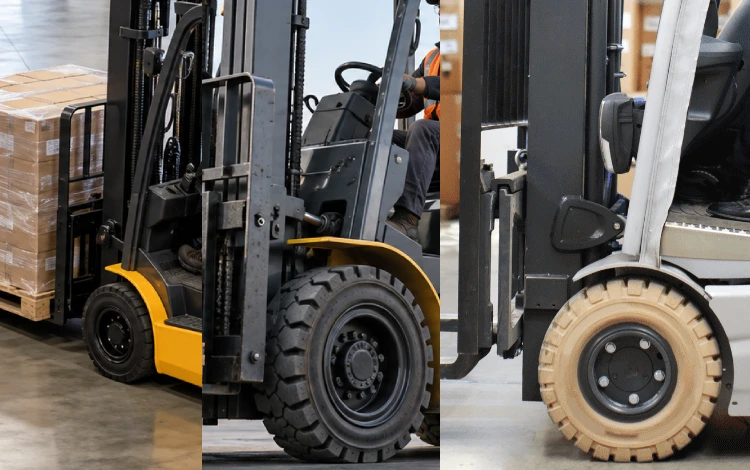
- Air-filled pneumatic tires — resilient and comfortable on uneven ground, but vulnerable to punctures and pressure loss.
- Solid pneumatic tires — shaped like pneumatic tires but made from solid rubber, offering good durability and no puncture-related downtime.
- Cushion tires — solid rubber tires pressed onto a steel band, normally used on compact industrial forklifts working on smooth surfaces.
- Polyurethane wheels — low-rolling-resistance wheels commonly fitted to warehouse equipment such as reach trucks, pallet trucks, and electric stackers.
- Non-marking tires — a material option for applications where dark floor marks or contamination must be reduced.
These categories overlap. For example, a solid tire can be supplied in a pneumatic profile, while a cushion tire is also solid. That is why we prefer to discuss the tire together with the truck rather than treating “solid” as a complete specification.
Why We Ask About the Workplace Before Recommending a Forklift
From a forklift factory’s perspective, tire selection starts with the site. Before we recommend one of our electric, diesel, LPG, reach-truck, or stacker configurations, we normally want to know:
- Will the forklift work indoors, outdoors, or both?
- Is the surface smooth concrete, asphalt, compacted ground, gravel, or an uneven yard?
- Are there metal scraps, nails, timber fragments, or other puncture hazards?
- What is the load weight, size, and load-center distance?
- How many hours will the truck operate per shift?
- Does it need to pass through containers, doorways, ramps, or narrow aisles?
- Are low noise, low emissions, floor protection, or hygiene important?
- Will the truck work in high heat, cold storage, wet areas, or dusty conditions?
Two forklifts with the same nominal capacity can require very different configurations. A 3-ton truck unloading pallets in a clean warehouse is not doing the same job as a 3-ton truck crossing a rough outdoor yard. The correct decision must account for the entire machine.
Pneumatic Forklift Tires
What Is a Pneumatic Tire?
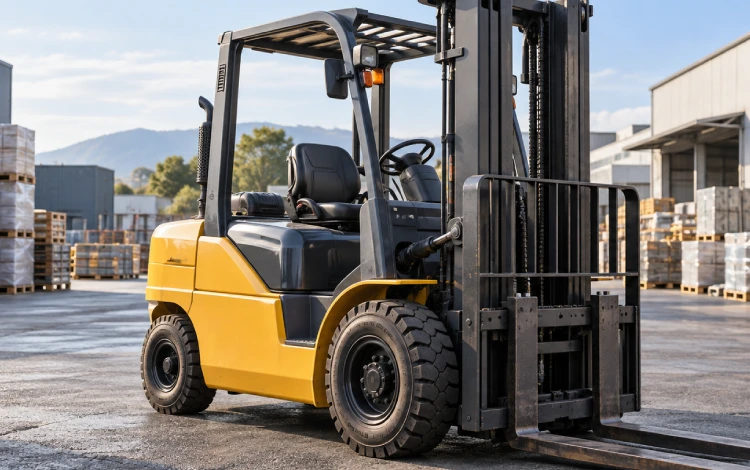
A pneumatic tire uses air pressure to support the load. In simple terms, the air inside the tire provides part of the cushioning between the truck and the ground. That is the practical pneumatic tire meaning in a forklift application.
Because they can absorb more surface irregularities than hard industrial wheels, pneumatic forklift tires are often considered for outdoor work, yards, ramps, and mixed surfaces. They can improve ride comfort and help the truck maintain contact with uneven ground. Treaded versions also provide useful traction when the surface is not perfectly clean or dry.
The trade-off is maintenance. Air-filled pneumatic tires for forklifts require correct inflation, routine inspection, and protection from puncture hazards. Low forklift tire pressure can increase heat, affect handling, and damage the tire. Excessive pressure is not a solution either; the correct value must follow the truck and tire specifications.
Which YULI Forklifts Suit Pneumatic Tires?
For regular outdoor material handling, we would usually begin the discussion with a counterbalance forklift rather than a warehouse truck.
- Our CPC20/25-K and CPC20/25-KII diesel models are practical starting points for general outdoor handling in the 2–2.5 ton range.
- The CPC30-38-K and CPC30-38-KII series suit customers who need approximately 3–3.8 tons of capacity for yards, manufacturing sites, and logistics operations.
- For heavier loads, the CPC40-50-H range and CPC100-H heavy-duty model should be considered according to the actual load and attachment.
- LPG20-38-K and LPG40-50-H models may be suitable where customers want LPG/dual-fuel operation with counterbalance-forklift versatility.
- Some electric counterbalance models, including the CPD series, can also be configured for mixed indoor and outdoor work when the surface, duty cycle, battery system, and weather conditions are suitable.
A pneumatic tire 4-wheel sit-down forklift is a familiar choice for general material handling, but the phrase alone does not define the machine. Capacity, wheelbase, ground clearance, powertrain, mast, and attachments still matter.
For genuinely rough ground, a standard forklift with pneumatic tires may still be the wrong answer. Construction sites, farms, mines, and poorly maintained yards may require a purpose-designed rough-terrain forklift with appropriate ground clearance, chassis geometry, and off-road forklift tires. Installing aggressive all-terrain forklift tires on a warehouse-oriented truck does not turn it into a rough-terrain machine.
Solid Pneumatic Forklift Tires
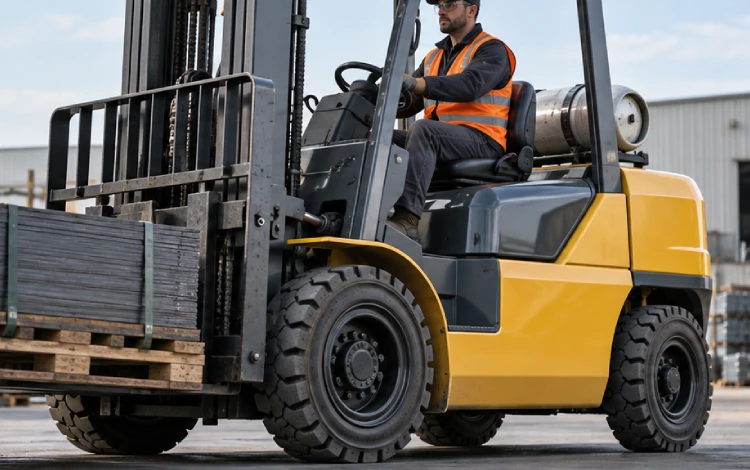
A solid pneumatic tire has the external profile of a pneumatic tire but contains solid rubber rather than compressed air. It cannot suffer a conventional air puncture, which is its clearest operational advantage.
For customers working around metal offcuts, recycling material, broken pallets, sharp stone, or construction debris, solid pneumatic tires for forklifts can reduce puncture-related downtime. They are also widely considered for intensive industrial work where reliability matters more than maximum ride softness.
However, “puncture-proof” does not mean “maintenance-free.” Solid forklift tires still wear, cut, chunk, overheat, and separate if they are overloaded, misapplied, damaged, or run for too long. Their condition must be included in the daily inspection.
Where We Commonly Consider Solid Pneumatic Tires
On suitable counterbalance models, a solid pneumatic configuration may make sense for:
- Manufacturing plants with floor debris
- Timber and building-material yards
- Recycling and waste-handling operations
- Busy logistics yards where puncture downtime is costly
- Mixed indoor/outdoor routes on reasonably firm surfaces
For a customer considering a CPC diesel forklift or an LPG counterbalance truck, we compare the ground condition and operating intensity before choosing between air-filled and solid pneumatic forklift tires. For an electric CPD truck, we also consider the added rolling resistance and its effect on energy use and duty cycle.
The key point is that solid tires for forklifts must still be approved for the machine, rim, load, speed, and operating conditions. A tire change can affect ride quality, vibration, heat generation, traction, and component stress.
Cushion Forklift Tires
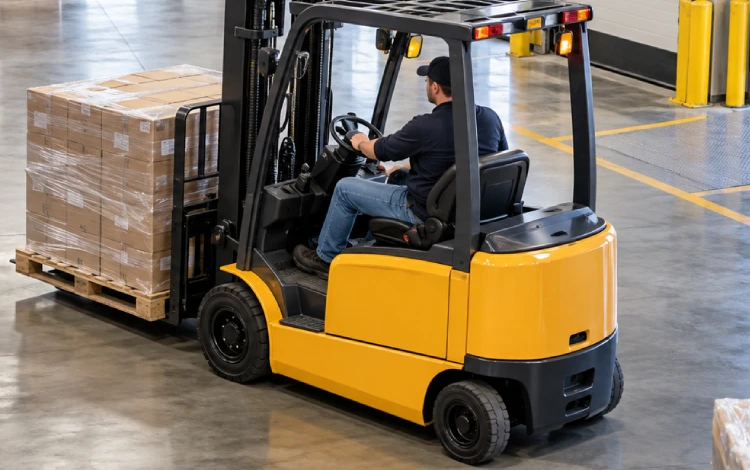
A cushion tire is a solid rubber tire bonded or pressed onto a steel band. It normally has a smaller outside diameter than a comparable pneumatic-profile tire. This allows a compact chassis and a tighter turning radius, which is why cushion tire forklifts are strongly associated with indoor industrial work on smooth floors.
The main advantages of cushion tire forklifts are their compact dimensions, puncture resistance, and suitability for tight indoor layouts. They can be a good fit for loading docks, production plants, and warehouses where the floor is level and turning space is limited.
The limitations are just as important. A cushion tire forklift has lower ground clearance and transmits more shock on joints, potholes, gravel, and broken pavement. It should not be selected merely because the tire cannot puncture. If the route includes rough outdoor ground, a pneumatic-profile truck is usually the more sensible starting point.
Cushion Tire vs Pneumatic Tire
The practical cushion tire vs pneumatic tire comparison looks like this:
| Selection factor | Cushion tires | Pneumatic-profile tires |
|---|---|---|
| Best surface | Smooth indoor floors | Outdoor or mixed, firmer uneven surfaces |
| Turning space | Often more compact | Usually requires more room |
| Ground clearance | Lower | Higher |
| Ride over rough ground | Harsher | Better cushioning, especially air-filled |
| Puncture risk | No air puncture | Air-filled versions can puncture; solid pneumatic versions cannot |
| Typical truck concept | Compact industrial counterbalance | General-purpose counterbalance or rough-terrain design |
When customers ask us about forklift cushion tires vs. pneumatic, we first confirm whether they are comparing tires or complete truck classes. In many cases, cushion and pneumatic trucks use different chassis, steering geometry, and clearances. This is not always a simple tire swap.
Polyurethane Wheels for Warehouse Equipment
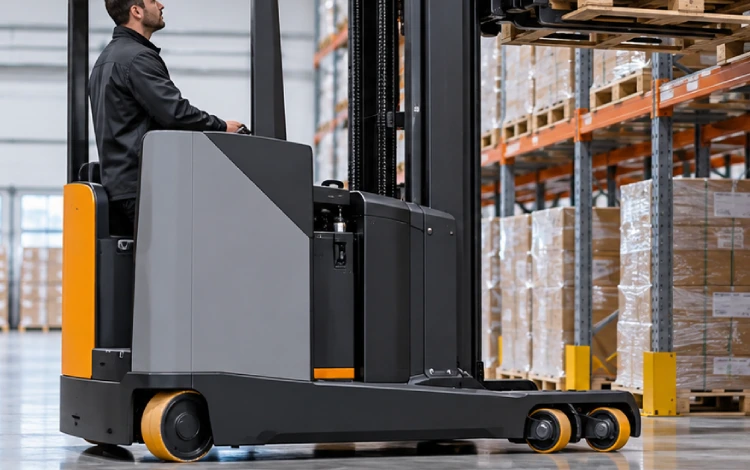
Polyurethane forklift tires—more accurately called polyurethane wheels in many warehouse applications—are commonly used on electric pallet trucks, electric stackers, reach trucks, and similar indoor equipment.
They have low rolling resistance, compact dimensions, and good wear characteristics on smooth floors. Those qualities suit battery-powered warehouse equipment, where energy efficiency and maneuverability are important.
At YULI, we would normally discuss polyurethane wheels when recommending:
- A walk-behind or stand-on electric stacker for pallet stacking
- A seated or stand-on reach truck for high-rack storage
- Compact electric warehouse equipment used on level indoor floors
We would not normally recommend a reach truck simply because a customer wants to work outdoors. Reach trucks are designed around warehouse aisle and racking requirements. Their small, hard wheels need a smooth, clean surface. Expansion joints, dock plates, debris, water, and uneven pavement must all be assessed before the truck is selected.
Non-Marking Forklift Tires
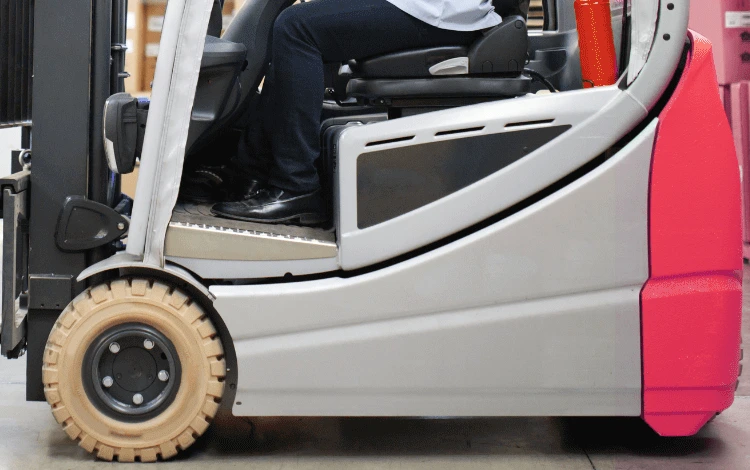
Non-marking forklift tires are made to reduce the dark marks that conventional black rubber can leave on floors. They may be useful in food-related facilities, pharmaceutical operations, clean production areas, retail environments, or warehouses with strict housekeeping requirements.
Customers sometimes call them forklift white tires, although non-marking compounds are not always pure white. The material formulation differs from conventional black rubber, so traction, wear, heat, static control, and cost should be checked for the application.
Non-marking does not mean that a tire can never leave residue, nor does it automatically mean anti-static. If static dissipation is a safety requirement, it must be specified separately and confirmed as part of the complete truck configuration.
For a clean indoor application, a non-marking option may be considered on an appropriate CPD electric counterbalance forklift, reach truck, or electric stacker. We would still ask about load, floor condition, travel distance, duty cycle, and cleaning requirements before finalizing the configuration.
Tire Materials and Tread Patterns
Most counterbalance rubber forklift tires are designed around industrial load and durability requirements, while polyurethane is common on smaller warehouse-equipment wheels. Within those broad material groups, compound, construction, and tread vary.
Deep tread can support traction on loose or wet surfaces, but deep tread forklift tires are not automatically the best choice everywhere. On a smooth indoor floor, an unnecessarily aggressive pattern may increase vibration and wear. Likewise, the steer axle and drive axle perform different jobs, so forklift steer tires and drive tires must be selected and inspected with their positions in mind.
There is no honest “all-purpose” answer. Products marketed as all-purpose forklift tires still have operating limits. We prefer to define the route and duty first, then approve the tire configuration for the selected forklift.
Forklift Tire Size: Why the Numbers Are Not Enough
Customers often search for a forklift tire size chart and expect it to identify the correct replacement. Size markings such as 5.00-8, 6.00-9, 7.00-12, or 8.25-15 are common examples in the material-handling market. Warehouse equipment may use formats such as 18x6x12 1/8 or 14×4.5×8.
Those numbers alone are not sufficient to approve a tire.
A correct match must consider:
- The exact forklift model and serial configuration
- Front or rear axle position
- Tire construction and load rating
- Rim profile and dimensions
- Single- or twin-tire arrangement
- Required clearances
- Maximum travel speed and duty cycle
- Approved inflation pressure for pneumatic tires
For example, seeing a 6.00-9 solid forklift tire or 7.00-12 solid forklift tire advertised online does not prove that it belongs on a particular YULI model. The same caution applies to a 23×9-10 forklift tire or any other size. Check the truck data, wheel assembly, and approved specification before ordering or fitting replacements.
Forklift Wheels, Rims, and Tires Must Be Treated as a System
The tire does not work by itself. Forklift wheels and tires must match the hub, rim, axle, brakes, clearances, and rated performance of the truck.
We advise customers not to mix incompatible constructions or substitute forklift rims based only on diameter. Split-rim and multi-piece assemblies require trained handling because stored energy and incorrect assembly can create serious hazards. Tire pressing, inflation, removal, and installation should be carried out by qualified personnel using the correct equipment and procedures.
If a customer wants to convert from air-filled pneumatic to solid pneumatic, or from one tread or compound to another, we ask them to confirm the change with the forklift manufacturer or an authorized technical representative. Forklift tires pneumatic vs. solid is not only a purchase-price decision; it can change vibration, heat, energy consumption, and how the truck behaves.
How We Match Tire Type to a YULI Forklift
The table below shows how we begin the conversation. It is a selection guide, not a final specification.
| Working application | Forklift direction we would discuss | Typical tire/wheel direction |
|---|---|---|
| Clean indoor warehouse, general pallet handling | CPD electric counterbalance forklift | Suitable solid, pneumatic-profile, or non-marking option, depending on model and floor |
| Tight indoor maneuvering | CPE15/20 three-wheel electric forklift | Indoor industrial configuration approved for the model |
| High-rack, narrow-aisle storage | Seated or stand-on reach truck | Polyurethane warehouse wheels on smooth floors |
| Pallet stacking over short indoor distances | Walk-behind or stand-on electric stacker | Polyurethane drive and load wheels |
| Outdoor yard and general industrial handling | CPC20/25-K, CPC30-38-K, or CPC40-50-H diesel series | Pneumatic or solid pneumatic configuration according to surface and puncture risk |
| LPG/dual-fuel counterbalance work | LPG20-38-K or LPG40-50-H | Pneumatic or solid pneumatic configuration according to site conditions |
| Heavy-load handling | CPC100-H or another correctly rated heavy-duty configuration | Industrial tire system approved for load, axle, surface, and duty |
| Construction, agriculture, or genuinely rough ground | Purpose-designed rough-terrain forklift | Large pneumatic-profile, all-terrain configuration approved for the truck |
The model comes first. Tire choice refines the machine for its work; it does not replace correct forklift selection.
Forklift Tire Maintenance: What Operators Should Check
Good forklift tire maintenance begins with a pre-shift visual inspection. Operators should follow the truck manual and site procedures, and report anything outside the approved limits.
Typical checks include:
- Cuts, cracks, chunking, embedded objects, or exposed material
- Uneven wear or flat spots
- Separation between rubber and band or rim
- Missing rubber beyond the allowable wear limit
- Damage to forklift wheels, wheel nuts, and rims
- Correct inflation pressure on air-filled pneumatic tires
- Heat, vibration, steering pull, or unusual noise during operation
- Debris wrapped around warehouse-equipment wheels
Do not judge replacement timing by appearance alone. Wear limits depend on the tire and truck specification. A damaged or heavily worn tire changes effective ride height and can affect ground clearance, mast angle, stability, and braking behavior.
We also recommend replacing tires in the correct axle arrangement rather than creating a large mismatch in rolling diameter or wear. The service decision should be made by trained personnel familiar with the truck and tire system.
What About Forklift Tire Price?
Searches such as “forklift tires for sale,” “forklift tire price,” or “how much are forklift tires?” usually produce a wide range of results. That is expected because price changes with size, construction, compound, brand, load rating, tread, region, and installation method.
As a forklift factory, we do not present ourselves as the best place to buy solid forklift tires, nor do we publish a general tire price list. When we quote a new forklift, we specify an appropriate tire option as part of the complete machine. For replacement tires, the customer should provide the forklift model, serial configuration, existing tire markings, rim information, application, and operating conditions to a qualified local service provider or approved supplier.
The cheapest tire can become expensive if it causes frequent downtime, poor traction, excessive vibration, or short service life. The most expensive tire is not automatically the best either. The correct measure is suitability over the truck’s real duty cycle.
Common Selection Mistakes We See
Choosing only by tire size
A matching sidewall number does not confirm the construction, load rating, rim, or application.
Assuming solid tires work everywhere
Solid tires eliminate air punctures, but they can create a harsher ride and more vibration. Rough terrain may call for a different truck, not simply a harder tire.
Using warehouse equipment outdoors
Polyurethane wheels work well on smooth floors. They are not intended to compensate for potholes, gravel, or broken yard surfaces.
Treating cushion and pneumatic trucks as interchangeable
The pneumatic vs cushion tires decision often involves complete chassis geometry and ground clearance. It may not be a tire-only conversion.
Ignoring the load center and attachment
Tire selection cannot correct an undersized forklift. Long loads, shifted load centers, clamps, rotators, and other attachments can change residual capacity and must be considered when specifying the truck.
Our Practical Recommendation
If your work is mainly indoors on smooth concrete, begin with an electric counterbalance forklift, three-wheel electric forklift, reach truck, or stacker according to the load and aisle layout. We will then confirm whether the application calls for standard, non-marking, solid, or polyurethane running gear.
If the truck will work in a normal outdoor yard, begin with a correctly sized diesel, LPG, or suitable electric counterbalance model. Air-filled pneumatic tires can provide a more forgiving ride, while solid pneumatic tires can reduce puncture downtime.
If the ground is genuinely rough, do not choose a standard forklift simply because it can be fitted with outdoor forklift tires. Begin with a rough-terrain design and verify traction, gradeability, ground clearance, load capacity, and stability for the site.
In short, the best tire is the one that supports the right forklift doing the right job.
FAQ
What are pneumatic tires?
Pneumatic tires are tires that use compressed air to support the load and provide cushioning. On forklifts, they are commonly considered for outdoor or mixed-surface work. They require correct pressure and regular inspection.
What is the difference between solid pneumatic and air-filled pneumatic tires?
Both use a similar external profile. Air-filled tires generally provide better cushioning but can puncture or lose pressure. Solid pneumatic tires contain solid rubber, so they avoid air punctures but normally provide a firmer ride and can generate more heat.
Are cushion tires the same as solid pneumatic tires?
No. Both are airless, but a cushion tire is a compact rubber tire pressed onto a steel band, while a solid pneumatic tire has a larger pneumatic-style profile. They are usually associated with different truck designs and operating environments.
Can I replace pneumatic tires with solid forklift tires?
Sometimes a compatible solid pneumatic option is available, but the conversion should be approved for the forklift, rim, load, speed, clearances, and duty cycle. Do not make the change based only on nominal tire size.
Which forklift tires are best for outdoor use?
Air-filled or solid pneumatic tires are common choices for firm outdoor surfaces. For loose, muddy, or badly uneven ground, the correct solution may be a rough-terrain forklift with an approved all-terrain configuration.
Which tires are used on electric forklifts?
It depends on the electric truck. Counterbalance forklifts may use pneumatic-profile or solid industrial tires. Reach trucks and electric stackers commonly use polyurethane wheels for smooth indoor floors. The application and model determine the final choice.
Are non-marking tires suitable for every warehouse?
Not automatically. They can reduce visible floor marks, but wear, traction, heat, static behavior, and duty cycle must still be checked. Anti-static performance should be specified separately where required.
How long do forklift tires last?
There is no reliable universal number. Service life depends on load, floor condition, travel distance, turning, braking, heat, tire construction, pressure, alignment, and operator behavior. Inspect them routinely and follow the approved wear limits.
Does changing forklift tires affect load capacity?
It can affect ride height, stability, clearances, handling, and the way loads are transmitted to the truck. Capacity and tire compatibility should be confirmed with the forklift manufacturer or an authorized technical representative.
Conclusion
There are several different types of forklift tires, but tires should not be selected in isolation. At YULI, we look at the complete application: load capacity, load center, lift height, surface, aisle width, operating hours, power system, mast, attachments, and local working conditions.
We manufacture forklifts—not forklift tires. Our role is to recommend a suitable YULI truck and configure it with the right running gear for its intended work. Whether the answer is a CPD electric counterbalance forklift, a CPC diesel model, an LPG truck, a reach truck, an electric stacker, or a rough-terrain forklift depends on the whole job.
If you are planning a forklift purchase, send us the load details, working surface, lift height, aisle dimensions, daily operating hours, and delivery country. We can use that information to recommend a complete forklift configuration rather than asking you to choose a tire from a list.