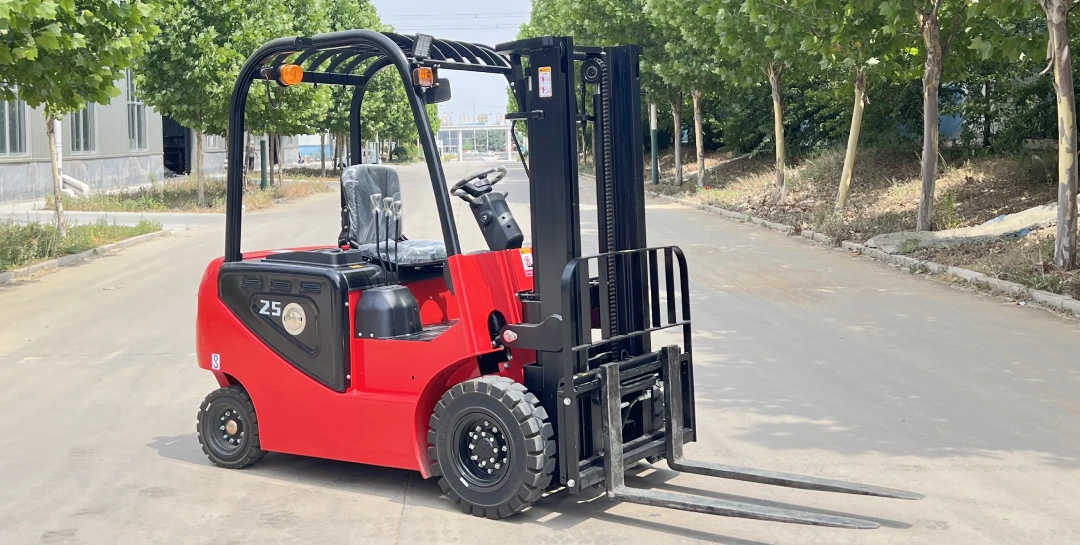
A forklift mast is the vertical lifting structure at the front of a forklift. It raises, lowers, and supports the forks, carriage, and load during material handling.
For buyers, the mast is not just a steel frame. It determines how high the forklift can lift, how low the truck can travel through a doorway, how much free lift is available, how clearly the operator can see forward, and whether the forklift can work safely in a warehouse, container, trailer, factory, or outdoor site.
At YULI, we do not recommend a mast only by maximum lift height. A mast that lifts high enough may still be wrong if the forklift cannot pass through a door, enter a container, maintain enough capacity at height, or give the operator proper visibility. The right mast depends on load weight, load center, lifting height, lowered mast height, free lift, aisle space, door clearance, attachments, and the real working environment.
What Is a Mast on a Forklift?
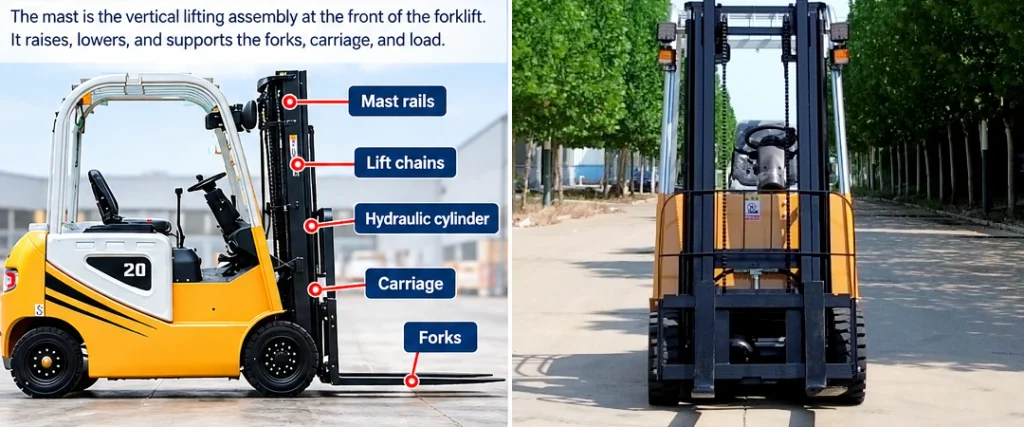
The mast on a forklift is the upright assembly that allows the forks and carriage to move up and down. It is normally located at the front of the forklift, directly behind the forks.
A forklift mast usually includes mast rails, lift cylinders, chains, rollers, the carriage, and related structural parts. The carriage holds the forks. The mast guides the carriage as it rises or lowers. The hydraulic system provides the lifting force.
In practical terms, the mast controls the forklift’s vertical working ability. It affects how high the forklift can stack pallets, how easily it can pass through low doors, and how suitable it is for high-rack storage or low-clearance work.
This is why mast selection is part of forklift selection. A forklift with the right capacity but the wrong mast may still fail in daily operation.
How Does a Forklift Mast Work?
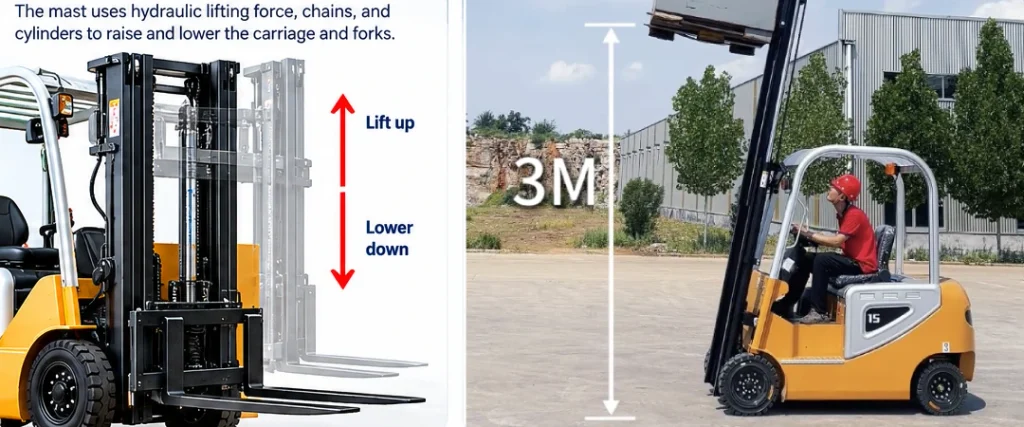
A forklift mast uses hydraulic lifting force to raise and lower the carriage, forks, and load. Depending on the mast design, hydraulic cylinders may act directly on the carriage or work through chains and pulleys to move the lifting assembly.
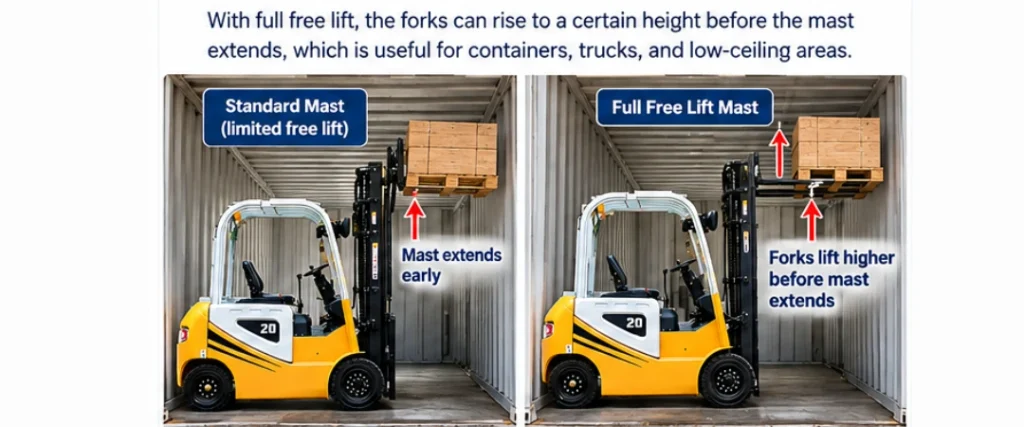
On some masts, the carriage rises only a limited distance before the mast sections begin to extend. On full-free-lift designs, the forks can rise farther before the mast’s overall height increases. This is useful when handling pallets inside containers, trailers, trucks, or buildings with low ceilings.
Tilt cylinders allow the mast to move forward and backward. Backward tilt helps stabilize the load during travel. Forward tilt is mainly used when placing or depositing a load. The correct lifting and tilting procedure depends on the forklift model, load, site conditions, and operator training.
Most forklift masts are hydraulic, but the mast structure can vary significantly depending on lift height, free lift, collapsed height, and application.
Common Forklift Mast Types
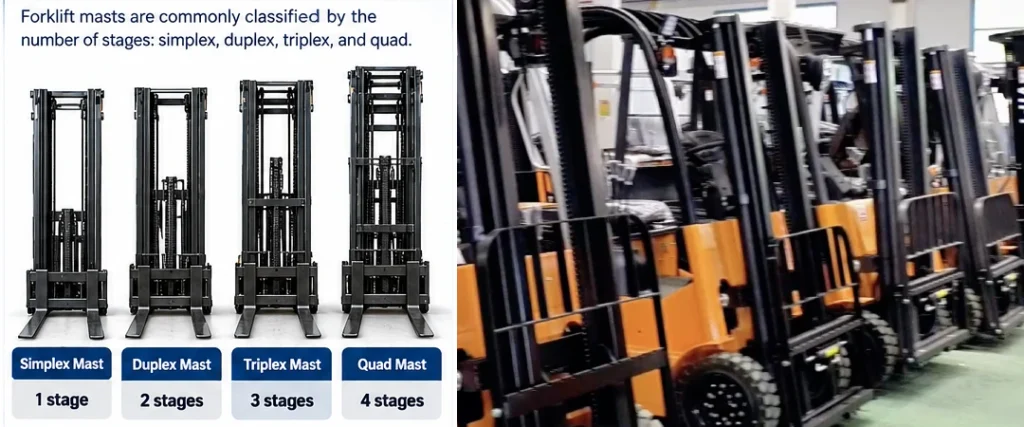
Forklift mast types are commonly classified by the number of mast stages. The main types are simplex, duplex, triplex, and quad. These names describe the mast structure, not the forklift’s power type.
| Mast Type | Stage Count | Basic Description | Typical Application |
|---|---|---|---|
| Simplex mast | 1 stage | Single-stage mast | Lower-height handling |
| Duplex mast | 2 stages | Two-stage mast | General warehouse work |
| Triplex mast | 3 stages | Three-stage mast | Higher stacking with limited collapsed height |
| Quad mast | 4 stages | Four-stage mast | Specialized high-lift applications |
Mast stage count affects lift height, lowered mast height, visibility, cost, and sometimes residual lifting capacity. More stages can help a forklift reach higher while keeping a lower collapsed height, but more stages are not automatically better for every buyer.
What Is a Simplex Mast on a Forklift?
A simplex mast, also called a single-stage mast, has one main lifting stage. It is usually used for lower lifting applications where high stacking is not required.
This type of mast can be suitable for simple loading, unloading, and low-height movement. It may also provide a relatively straightforward structure and good visibility, depending on the forklift design.
However, a simplex mast is usually not suitable for high-rack warehouse storage. If a customer needs to lift pallets to higher rack levels, a duplex or triplex mast may be more appropriate.
What Is a Duplex Mast on a Forklift?
A duplex mast is a two-stage mast. It has two mast sections and is commonly used in general warehouse and factory handling applications.
A duplex mast can offer more lift height than a simplex mast while remaining less complex than a triplex or quad mast. It may be suitable for standard pallet handling, loading docks, production areas, and moderate stacking heights.
However, buyers should still check lowered mast height, free lift, and the required doorway or container clearance. A two-stage mast may work well in many sites, but it is not always the best choice for low-clearance routes or higher racking systems.
What Is a Triplex or 3-Stage Mast on a Forklift?
A triplex mast, also called a 3-stage mast, has three mast sections. It is designed to provide higher lift height while keeping the lowered mast height more manageable than some simpler high-lift designs.
This makes a triplex mast useful in warehouses where the forklift must pass through lower doors or indoor routes before lifting pallets to higher racks.
For example, a forklift may need to travel through a warehouse doorway and then stack pallets several meters high. In this situation, a triplex mast may be more practical than a basic two-stage mast.
Still, a triplex mast should not be chosen only because it lifts higher. Buyers should check residual capacity at height, operator visibility, load center, and the actual mast dimensions.
What Is a Quad Mast Forklift?
A quad mast forklift uses a four-stage mast. It is designed for special high-lift applications where the forklift needs greater lifting height while keeping the lowered mast height within a workable range.
Quad masts can be useful in certain high-rack or restricted-clearance applications, but they are not required for most standard warehouse jobs. More mast sections can add complexity and may affect visibility through the mast.
Before selecting a quad mast, buyers should confirm the required lift height, lowest overhead clearance, load weight, load center, aisle width, attachment use, and residual capacity. If a triplex mast can safely do the job, it may be the more practical choice.
Free Lift and Low-Profile Mast Configurations
Free lift and low-profile mast configurations are related to mast performance, but they are not the same as mast stage count.
Free lift is the height the forks can rise before the mast’s overall height begins to increase. This matters when a forklift must lift a load in a place with limited overhead clearance.
Full free lift means the forks can rise substantially before the mast extends upward. This can be useful inside shipping containers, trailers, trucks, or buildings with low ceilings.
Low-profile mast or trucker’s mast generally refers to a mast configuration designed with a low collapsed height. It is often used where the forklift must work inside trailers, containers, or other low-clearance spaces.
For example, a warehouse operator may need to raise a pallet inside a shipping container. If the mast begins extending too early, it may hit the top of the container. A full-free-lift configuration may help solve this problem, depending on the exact mast design and required lifting height.
This is why buyers should not ask only for maximum lift height. They should also ask how much free lift is available and what the collapsed mast height is.
Forklift Mast Height: Lift Height, Lowered Height, and Door Clearance
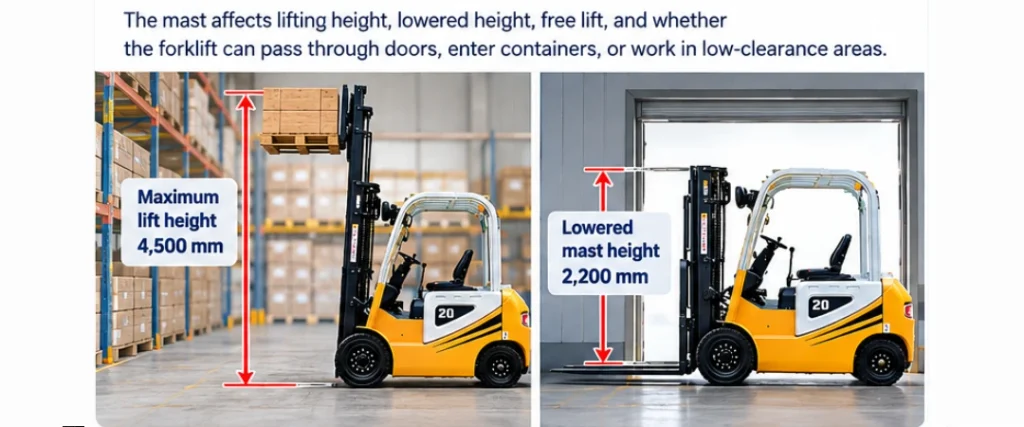
Mast height has several meanings, and confusing them can lead to the wrong forklift configuration.
Maximum lift height is how high the forks can raise the load.
Lowered mast height is the height of the mast when it is fully lowered.
Free lift is the height the forks can rise before the mast itself extends.
Overall forklift height may include the overhead guard, mast, load backrest, or other parts depending on configuration.
A forklift mast should be selected by comparing the required lifting height with the lowest overhead clearance in the working route. A forklift that lifts high enough may still be wrong if it cannot pass through a warehouse door, truck opening, container entrance, or production area.
Example: Choosing a Mast for a Warehouse
Suppose a warehouse doorway is 2,200 mm high, and the required lifting height is 4,500 mm.
In this case, the buyer needs a forklift mast that can lift to 4,500 mm, but the forklift also needs to travel through a 2,200 mm doorway before it reaches the storage area. The buyer must check lowered mast height, overall forklift height, free lift, required clearance margin, and capacity at the required lifting height.
A suitable triplex mast configuration may meet these requirements, but the exact dimensions must be verified against the manufacturer’s specifications. This example is only an illustrative selection scenario, not a confirmed YULI model specification.
When Should You Tilt a Forklift Mast Forward?
Forward mast tilt should be used carefully.
When traveling with a load, the mast is usually tilted slightly backward to help keep the load stable. Forward tilt is mainly used when placing a load onto a rack, depositing a pallet, or positioning goods at the final location.
When picking up a load, the forks should be inserted fully and correctly. After the load is secured, the mast is commonly tilted back slightly before travel.
Operators should avoid traveling with the mast tilted forward, especially when carrying a raised load. Forward tilt can move the load center forward and reduce stability if used incorrectly. The exact operation should follow workplace safety rules, operator training, and the forklift manufacturer’s instructions.
What Is a Forklift Mast Guard?
The term “mast guard” may be used differently by different manufacturers. In general, it refers to guarding around mast-related moving parts, such as chains, rollers, and lifting components.
A mast guard should not be confused with the overhead guard or the load backrest. The overhead guard protects the operator from objects falling from above. The load backrest helps support the load and reduce the risk of goods falling backward toward the operator. Mast-related guarding is mainly associated with moving parts in the mast area.
Operators should never place hands, arms, or other body parts inside the mast structure while the forklift is operating or while the mast is raised. Guarding helps reduce risk, but it does not replace proper operation, maintenance, and training.
What Can Cause a Forklift Mast to Lower Unexpectedly?
A forklift mast should not lower unexpectedly during normal operation. If the mast slowly lowers or drops without control input, the forklift should be removed from service and inspected by qualified personnel.
Possible causes may include hydraulic leakage, worn seals, internal cylinder leakage, control valve issues, hose damage, overloading, poor maintenance, or other hydraulic system problems.
A mast that slowly lowers is a safety concern. The operator should not continue using the forklift until the cause has been checked and corrected.
Regular inspection and maintenance are important because the mast, chains, cylinders, rollers, and hydraulic system all work together under load. Any weakness in that system can affect lifting performance and safety.
How YULI Helps Buyers Choose the Right Forklift Mast
As a forklift manufacturer, YULI reviews mast selection as part of the full forklift configuration. We do not recommend a mast only by maximum lifting height.
For warehouse pallet handling, YULI electric counterbalance forklifts cover listed rated loads from 1 ton to 5 tons with typical lifting heights of 3-6 meters. These models are often considered for warehouse loading, factory logistics, and indoor material handling. Mast choice should be matched with pallet weight, lifting height, aisle width, lowered mast height, and door clearance.
For compact indoor work, YULI three-wheel electric forklifts such as the CPE15/20 series cover listed rated loads of 1.5-2 tons with lifting heights of 3-6 meters. In these applications, mast height, turning space, and forward visibility are especially important.
For outdoor yards and heavier work, YULI diesel forklifts cover listed rated loads from 2 tons to 10 tons with typical lifting heights of 3-6 meters. These forklifts may be suitable for industrial yards, building materials, and heavier handling applications. Mast selection should be reviewed together with load size, load center, ground condition, and tire configuration.
For high-rack warehouse storage, YULI reach forklifts offer listed rated loads of 1.5-3 tons and lifting heights of 3-8 meters. In this case, mast selection becomes especially important because lift height, residual capacity, aisle width, rack depth, and floor flatness must be considered together.
For uneven outdoor sites, YULI rough-terrain forklifts cover listed rated loads of 1.5-5 tons with lifting heights of 3-6 meters. These machines are selected for traction and mobility on suitable outdoor surfaces, but the mast still needs to match the load, lifting height, and jobsite stability requirements.
| Application | YULI Product Direction | Mast Selection Focus |
|---|---|---|
| Warehouse pallet handling | Electric counterbalance forklift | Lift height, lowered mast height, door clearance |
| Compact indoor logistics | Three-wheel electric forklift | Turning space, visibility, mast height |
| High-rack storage | Reach forklift | Lift height, residual capacity, aisle width |
| Outdoor industrial yard | Diesel forklift | Load weight, mast strength, ground condition |
| Uneven outdoor site | Rough-terrain forklift | Stability, visibility, surface condition |
When customers ask us to recommend a forklift, we usually ask for load weight, load center, required lift height, lowest door or container height, aisle width, ground surface, attachment requirements, and daily operating conditions.
These details help us recommend a mast and forklift configuration that fits the real application, not just a theoretical lifting height.
Common Mistakes When Choosing a Forklift Mast
One common mistake is choosing a mast only by maximum lift height. A forklift may lift high enough but still fail to pass through a warehouse door, container entrance, or truck opening.
Another mistake is ignoring lowered mast height. This is especially important in indoor warehouses, cold storage facilities, containers, trailers, and production workshops.
Some buyers also assume a triplex mast is always better than a duplex mast. That is not always true. A triplex mast may offer higher lift and lower collapsed height, but it can also affect visibility, cost, and residual capacity.
Another common mistake is ignoring capacity at height. A forklift’s rated capacity at a lower height may not be the same as its capacity at a higher lift height.
Buyers should also consider visibility. A mast with more stages, rails, and chains may reduce the operator’s forward view. In busy warehouses, visibility affects both safety and efficiency.
Finally, attachments should not be forgotten. A clamp, side shifter, fork positioner, or extended forks can change the load center and reduce actual capacity. Mast and attachment selection should be reviewed together.
Conclusion
The mast on a forklift is the vertical lifting structure that raises, lowers, and supports the forks, carriage, and load. It affects lift height, lowered height, free lift, door clearance, visibility, stability, and capacity.
Common mast types include simplex, duplex, triplex, and quad designs. Free lift, full-free-lift configurations, and low-profile mast options should be considered separately from stage count.
For YULI buyers, mast selection should always be matched with load weight, load center, required lift height, aisle design, door clearance, working surface, attachment requirements, and real operating conditions. The right mast helps the forklift work safely, efficiently, and comfortably in its actual jobsite.
FAQ
What is the mast on a forklift?
The mast is the vertical lifting assembly at the front of a forklift. It raises and lowers the forks, carriage, and load.
How does a forklift mast work?
Most forklift masts use hydraulic cylinders, chains, rollers, and mast rails to raise and lower the carriage and forks.
What is a 3-stage mast on a forklift?
A 3-stage mast, also called a triplex mast, has three mast sections. It is used for higher lift heights while keeping lowered mast height more manageable.
What is a simplex mast on a forklift?
A simplex mast is a single-stage mast. It is commonly used for lower lifting applications where high stacking is not required.
How many forklift mast types are there?
Common mast stage types include simplex, duplex, triplex, and quad. Free lift and low-profile configurations are separate mast features.
When should a forklift mast be tilted forward?
Forward tilt is mainly used when placing or depositing a load. When traveling with a load, the mast is usually tilted slightly backward for stability.
What can cause a forklift mast to lower slowly?
Possible causes include hydraulic leakage, worn seals, internal cylinder leakage, control valve problems, hose damage, overloading, or poor maintenance.
How much space should there be between a forklift mast and a door?
The lowered mast height and overall forklift height should be lower than the door opening, with enough clearance for safe travel. The exact clearance should be confirmed for the site.