The load center distance of a standard forklift is commonly 24 inches, approximately 610 mm, for many counterbalance forklifts in the U.S. market. In many metric-market forklift specifications, 500 mm is also a common rated load center.
These two values are not interchangeable. A 24-inch load center is not the same as a 500 mm load center. The correct load center distance for any forklift must always be confirmed from the forklift’s capacity plate or manufacturer’s technical data.
This matters because forklift capacity is not only about weight. A forklift rated for 3 tons is rated under specific conditions, including load center, lifting height, mast configuration, attachment use, and other factors. If the load center moves farther forward, the forklift may not safely lift the same weight.
As a forklift manufacturer, we often see buyers begin with one simple question: “How many tons can this forklift lift?” That is a useful starting point, but it is not enough. A compact 3-ton pallet, a long steel bundle, and an irregular machine part can all weigh the same while creating very different lifting conditions.
What Is Load Center in Forklift?
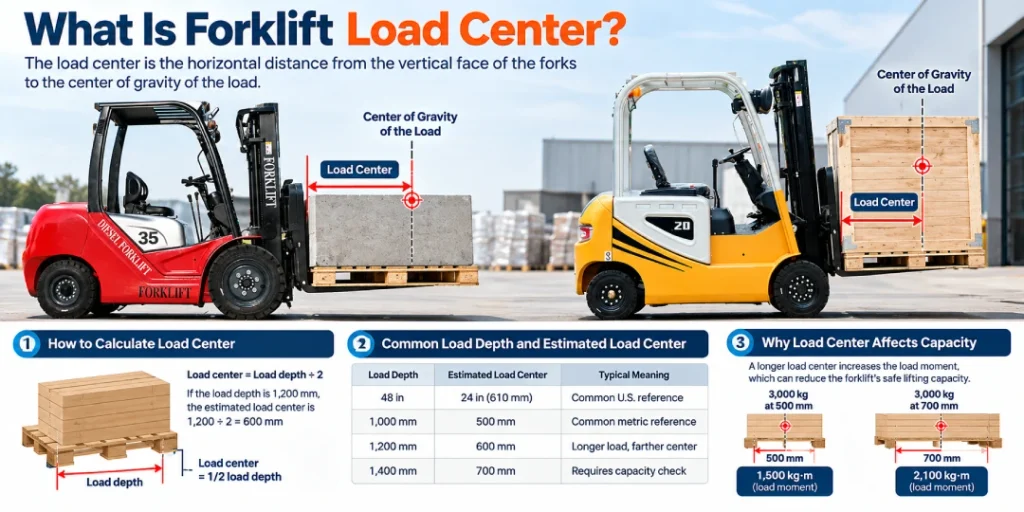
Load center in a forklift means the horizontal distance from the vertical face of the forks to the load’s center of gravity.
For a simple, evenly distributed pallet, the load center is usually half of the load depth. If a pallet is 48 inches deep, the load center is about 24 inches. If a load is 1,000 mm deep, the load center is about 500 mm.
| Load Depth | Estimated Load Center | Typical Meaning |
|---|---|---|
| 48 in | 24 in | Common U.S. reference |
| 1,000 mm | 500 mm | Common metric reference |
| 1,200 mm | 600 mm | Longer load, farther center |
| 1,400 mm | 700 mm | Capacity must be checked carefully |
This simple estimate only works when the load weight is evenly distributed. If the load is heavier at the front, longer than a standard pallet, liquid-filled, suspended, or irregular in shape, the real center of gravity may not be at the geometric center.
That is why load center is not just a training term. It directly affects forklift selection, lifting capacity, and operating safety.
Where Is the Load Center on a Forklift?
The load center is measured from the vertical face of the forks forward to the center of gravity of the load.
It is important to understand that the load center is not a fixed component installed on the forklift. It is a measurement related to the load being carried. The same forklift can handle different loads with different load centers.
For example, if a forklift carries a compact pallet with evenly distributed weight, the load center may be close to the rated value shown on the capacity plate. If the same forklift carries a long machine part or pipe bundle, the center of gravity may sit farther forward. That increases the load moment and can reduce safe lifting capacity.
In practical terms, the buyer should not only ask, “How heavy is the load?” A better question is, “Where is the weight actually concentrated?”
Which Dimension Defines the Load Center Length?
The dimension that defines the load center length is the horizontal distance from the fork face to the load’s center of gravity.
It is not the full pallet length. It is not the fork length. It is not the distance from the forklift body to the end of the forks.
For an evenly distributed load, the load center is usually half of the load depth. A 1,200 mm deep pallet has an estimated 600 mm load center. A 1,000 mm deep pallet has an estimated 500 mm load center.
But real loads are not always simple. A paper roll, engine part, mold, steel bundle, drum, or machinery component may have a center of gravity that is not in the middle. In those cases, forklift selection should be based on the actual load center, not just the outside dimensions.
How to Calculate Forklift Load Center
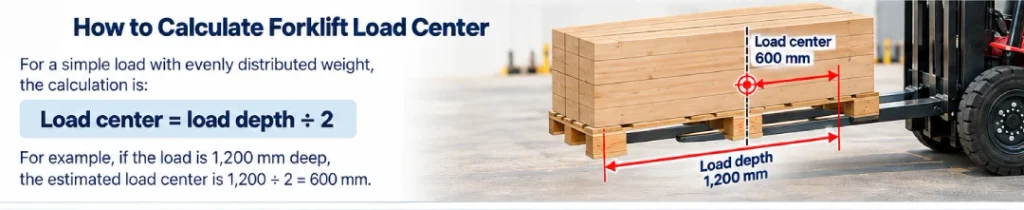
For a simple load with evenly distributed weight, the calculation is:
Load center = load depth / 2
For example, if the load is 1,200 mm deep, the estimated load center is:
1,200 mm / 2 = 600 mm
If the load is 48 inches deep, the estimated load center is:
48 inches / 2 = 24 inches
This calculation is useful for standard palletized goods. It gives buyers and operators a quick way to understand whether the load is close to the forklift’s rated condition.
However, the formula should not be used blindly. If the load is uneven, offset, suspended, unstable, or handled with an attachment, the real load center may be different. A forklift clamp, fork positioner, side shifter, or extended forks can also affect actual capacity because attachments add weight and may move the load farther forward.
For non-standard loads, the safest approach is to consult the forklift manufacturer or a qualified technical team.
Why Load Center Affects Forklift Capacity
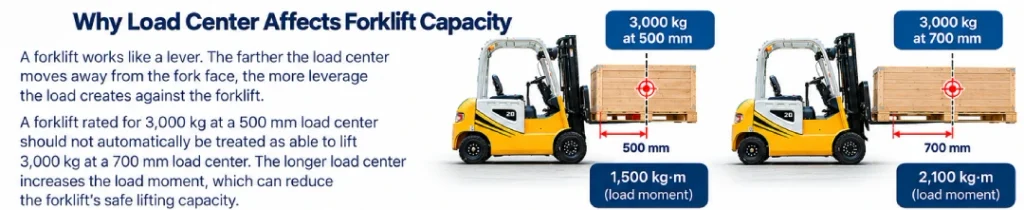
A forklift works like a lever. The farther the load center moves away from the fork face, the more leverage the load creates against the forklift.
This is why a forklift rated for 3,000 kg at a 500 mm load center should not automatically be treated as able to lift 3,000 kg at a 700 mm load center. The longer load center increases the load moment.
Here is a simple conceptual comparison:
| Same Load Weight | Load Center | Load Moment |
|---|---|---|
| 3,000 kg | 0.5 m | 1,500 kg·m |
| 3,000 kg | 0.7 m | 2,100 kg·m |
The second load creates 40% more load moment relative to the fork face.
This does not mean a forklift’s safe lifting capacity can be calculated only from this simple comparison. Actual capacity must come from the manufacturer’s approved capacity information. But the example shows why a longer load center can reduce usable lifting capacity.
A customer may request a 3-ton forklift for handling steel components. If the load is 1,400 mm deep with evenly distributed weight, its estimated load center is 700 mm. That is different from a forklift rated at a 500 mm load center. Before confirming the model, the supplier needs to check the actual load dimensions, center of gravity, lifting height, attachment use, and applicable capacity chart. A larger forklift or a different handling method may be necessary.
Load Center, Center of Gravity, and Forklift Stability
Load center and center of gravity are closely related, but they are not exactly the same.
The center of gravity is the point where the weight of the load is concentrated. The load center is the horizontal distance from the fork face to that point.
When loading a forklift, the center of gravity of the load combines with the forklift’s own center of gravity. Together, they form a combined center of gravity. If that combined center of gravity moves outside the forklift’s stability area, the forklift can become unstable.
This risk increases when the load is too heavy, too far forward, raised too high, tilted incorrectly, or carried across uneven ground.
This is also why lifting height matters. The physical load center may not change simply because the forks are raised, but the forklift’s stability and available capacity can change as the load is lifted higher.
Safe operation begins before the forklift is delivered. The forklift must be selected correctly for the load, site, and application.
How Attachments and Lift Height Affect Load Center
Attachments can change the real lifting condition of a forklift.
A side shifter, fork positioner, clamp, rotator, extended fork, or other attachment adds weight to the front of the forklift. Some attachments also move the load farther forward. Both factors may reduce the forklift’s actual lifting capacity.
This is why a forklift capacity plate should be updated or checked when attachments are used. A forklift that can lift a certain load with standard forks may not have the same capacity when fitted with a heavy attachment.
Lift height also matters. A forklift may have one capacity at a lower height and a different residual capacity at a higher lift height. This is especially important for high-rack warehouses, reach trucks, and applications where the load must be lifted several meters above the ground.
For buyers, this means the right question is not only, “Can this forklift lift 3 tons?” The better question is:
Can this forklift lift this specific load, at this load center, to this required height, with this attachment?
How to Check a Forklift’s Rated Load Center
The rated load center is usually shown on the forklift’s capacity plate, data plate, or technical specification sheet.
This information may include rated capacity, load center, lifting height, mast type, attachment information, and truck weight. Operators and buyers should not remove or ignore the capacity plate. It is one of the most important references for safe forklift use.
If the application is standard pallet handling, the rated load center may be easy to match. If the load is oversized, uneven, high-lift, or attachment-based, the capacity plate should be reviewed carefully.
For new forklift purchases, buyers should provide the supplier with load weight, load dimensions, load center or pallet depth, lifting height, working surface, aisle width, and attachment requirements. This allows the manufacturer to recommend a more suitable configuration.
Can Load Center Change from Forklift to Forklift?
Yes, load center conditions can change from one forklift to another.
Many standard counterbalance forklifts use common rated load centers such as 24 inches or 500 mm, but not every forklift is rated in the same way. Larger-capacity forklifts, reach trucks, rough-terrain forklifts, telehandlers, and forklifts fitted with special attachments may have different capacity conditions.
This is why buyers should not rely only on general rules. The forklift’s capacity plate, technical specification, and manufacturer recommendation are more important than a simple online answer.
If the application involves high lifting, long loads, special attachments, or outdoor working conditions, the load center should be reviewed carefully before model selection.
How YULI Helps Buyers Select the Right Forklift
As a forklift manufacturer, YULI uses load center information to help customers avoid choosing a forklift only by rated tonnage. A forklift model may look suitable on paper, but the real application can change the recommendation.
YULI offers different forklift configurations for warehouse, factory, outdoor yard, construction, and high-reach handling applications. When we review a customer’s working conditions, load center is one of the key points we check.
| Application | YULI Forklift Options | Listed Rated Load | Listed Lifting Height | Why Load Center Matters |
|---|---|---|---|---|
| Standard pallet handling | CPD electric counterbalance forklifts | 1-5 tons | 3-6 m | Pallet depth and weight distribution affect capacity |
| Compact indoor handling | CPE three-wheel electric forklifts | 1.5-2 tons | 3-6 m | Turning space, pallet size, and load stability must match |
| Long or heavy outdoor loads | CPC diesel forklifts | 2-10 tons | 3-6 m | Long loads may create an extended load center |
| High-rack warehouse storage | Seated and stand-on reach forklifts | 1.5-3 tons | 3-8 m | Load center, lift height, and rack depth must be checked together |
| Uneven outdoor surfaces | Rough-terrain forklifts | 1.5-5 tons | 3-6 m | Surface condition and load shape affect stability |
| High-reach outdoor handling | Diesel telehandler | 5 tons | 13.8 m lift, 7 m reach | Working radius and boom extension are critical |
For indoor warehouse handling, YULI electric forklifts may be suitable for pallet handling, factory logistics, and warehouse loading. But the actual load center, pallet depth, aisle width, and daily working hours should still be checked before confirming the model.
For outdoor yards and heavier material handling, YULI diesel forklifts can be considered for industrial sites and heavy-duty applications. However, a long 5-ton load is not the same as a compact 5-ton pallet. The load center must be reviewed before model confirmation.
For high-rack warehouse storage, YULI reach forklifts are often selected for space efficiency. In this case, load center, lifting height, aisle width, rack depth, and floor flatness should be reviewed together.
For telehandler applications, load center and working radius become even more important because the boom position changes the lifting condition. The required load, reach, height, and jobsite stability must all be checked.
Before recommending a forklift, we usually ask customers for the load weight, load length, load width, load height, pallet depth, estimated load center, maximum lifting height, working surface, indoor or outdoor use, aisle width, daily operating hours, attachment requirements, and preferred power type.
This helps us recommend a forklift configuration that matches the real job, not just the number printed in a brochure.
Common Forklift Load Center Mistakes
A common mistake is assuming that rated capacity is always available. It is not. Rated capacity applies only under the conditions stated by the manufacturer.
Another mistake is thinking load center matters only for heavy loads. Even a lighter load can create problems if it is very long, uneven, or carried too far forward.
Some buyers also forget to include attachments in the capacity calculation. Attachments add weight and may move the load center forward. This can reduce the forklift’s actual lifting capacity.
Another common mistake is using pallet size alone. Pallet depth helps estimate load center, but the weight distribution inside the load is equally important.
When in doubt, the safest approach is to check the capacity plate and consult the manufacturer before lifting a non-standard load.
Conclusion
The load center distance of a standard forklift is commonly 24 inches, approximately 610 mm, in many U.S. forklift ratings. In metric-market specifications, 500 mm is also a common rated load center. These values are not the same, and the correct rated load center must always be confirmed from the forklift’s capacity plate or manufacturer’s technical data.
Load center is the horizontal distance from the vertical face of the forks to the load’s center of gravity. It affects capacity, stability, lifting performance, and forklift selection. If the load center moves farther forward, the forklift’s safe lifting ability may decrease.
At YULI, we recommend choosing a forklift based on load weight, load center, lifting height, working environment, attachment requirements, and operating conditions together. That is the practical way to select a forklift that is safer, more efficient, and better matched to the real job.
FAQ
Does a longer load center reduce forklift lifting capacity?
Yes. A longer load center increases the load moment, which may reduce the forklift’s available lifting capacity. Always check the capacity plate or manufacturer’s approved capacity information.
Can a forklift lift its rated load at a 700 mm load center?
Not necessarily. If the forklift is rated at 3,000 kg at a 500 mm load center, it should not automatically be assumed capable of lifting 3,000 kg at a 700 mm load center. The capacity must be checked.
Is forklift load center measured horizontally or vertically?
Forklift load center is measured horizontally from the vertical face of the forks to the load’s center of gravity.
How do forklift attachments affect load center?
Attachments add weight and may move the load farther forward. This can reduce actual lifting capacity and may require a capacity check or updated capacity plate.
Where can you find a forklift’s rated load center?
You can usually find it on the forklift capacity plate, data plate, or technical specification sheet.
What is the standard load center for a forklift?
Many standard forklifts in the U.S. are rated at a 24-inch load center. In many metric specifications, 500 mm is also common. The exact value depends on the forklift model and capacity plate.