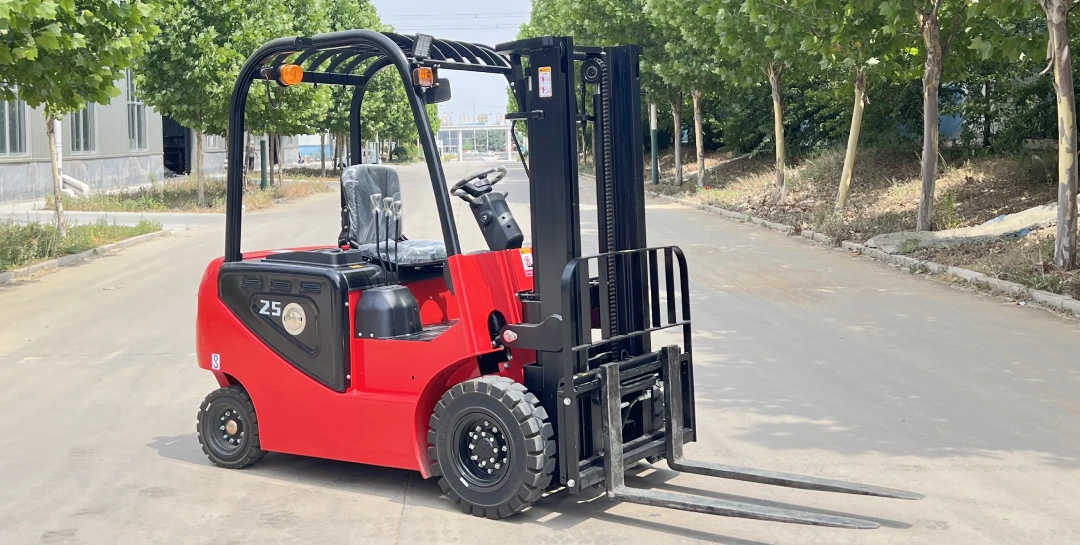
A forklift is a powered industrial truck used to lift, carry, stack, and move materials over short distances. Most forklifts use two steel forks to handle palletized goods, but different attachments can also help move drums, rolls, cartons, pipes, and other special loads.
For a warehouse manager, a forklift may be the machine that unloads 20 pallets every morning. For a factory, it may move raw materials from storage to the production line. For a construction site, it may carry steel, blocks, timber, or outdoor materials across uneven ground. The basic function is always similar, but the right forklift depends heavily on the job site.
That is why “what is a forklift?” is not only a definition question. It is also a selection question. A 1-ton electric forklift, a 3-ton diesel forklift, a reach truck, and a 5-ton rough-terrain forklift are all forklifts, but they are designed for different working conditions.
How Does a Forklift Work?
A forklift works by combining lifting power, vehicle movement, and load balance.
The forks slide under the pallet or load. The operator raises the forks through the mast, usually with hydraulic power. The forklift then carries the load to another location and lowers it safely.
On a counterbalance forklift, weight at the rear of the truck helps balance the load at the front. However, stability is not controlled by counterweight alone. Load weight, load center, mast height, mast tilt, attachment weight, tire condition, and ground surface all affect safe operation.
For example, a forklift rated for 3,000 kg at a 500 mm load center should not automatically be assumed capable of lifting 3,000 kg at a 700 mm load center. A longer load center increases the load moment and can reduce the forklift’s real lifting ability. The correct capacity must be checked from the manufacturer’s capacity plate or technical data.
This point matters in real buying decisions. A customer moving compact palletized goods may need a different forklift from a customer moving long steel parts, even if both loads weigh the same.
Main Parts of a Forklift
A forklift has several core parts.
The forks support the load. The mast raises and lowers the forks. The carriage holds the forks and moves along the mast. The counterweight helps balance the vehicle. The operator compartment includes the seat, controls, steering system, pedals, and display. The power system may be electric, diesel, LPG, or dual-fuel. The tires should match the working surface.
These parts sound simple, but small differences matter. A warehouse with narrow aisles may need a compact three-wheel electric forklift or reach truck. A yard with gravel may need pneumatic tires and stronger traction. A two-shift operation may need careful battery planning, not just a forklift with the correct lifting capacity.
Common Types of Forklifts
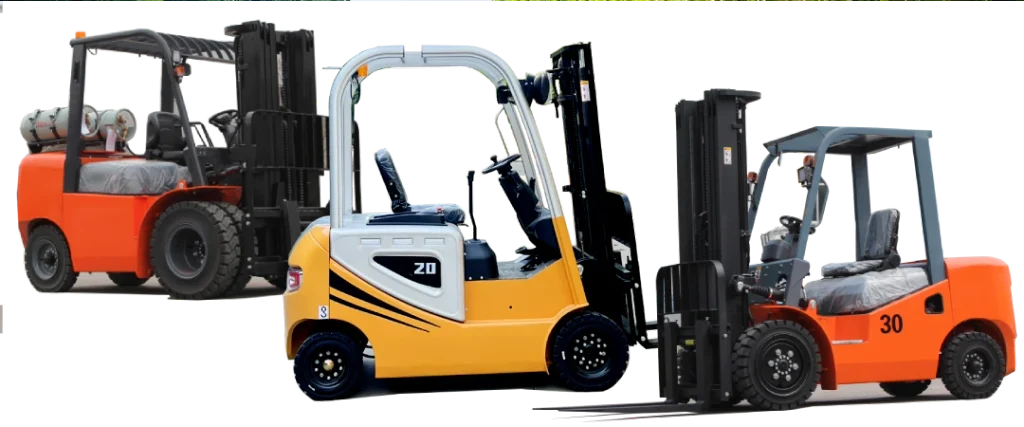
Forklifts can be grouped by truck structure and power source. This distinction is important. “Counterbalance forklift” describes the truck design. “Electric forklift” or “diesel forklift” describes the power system. A counterbalance forklift can be electric, diesel, LPG, or dual-fuel.
Electric Counterbalance Forklift
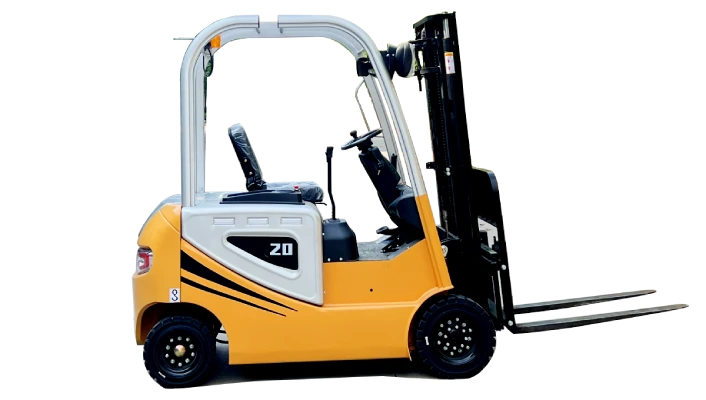
Electric forklifts are commonly used in warehouses, factories, food storage, packaging plants, and indoor logistics areas. They are quiet, clean during operation, and suitable for environments where exhaust emissions are not acceptable.
YULI electric forklift models include the CPD10 series with a 1-ton rated load, CPD15/20 series with 1.5-2 tons, CPD25 series with 2.5 tons, CPD30/35 series with 3-3.5 tons, and CPD40/45/50 series with 4-5 tons. These listed electric forklift models have a typical lifting height range of 3-6 meters.
A practical example: if a warehouse runs one daytime shift and has overnight charging time, a standard electric forklift may be easy to manage. If the same warehouse runs two shifts, the buyer should evaluate battery capacity, charging time, charging station layout, and whether opportunity charging is possible during breaks.
Three-Wheel Electric Forklift
A three-wheel electric forklift is useful where turning space is limited. YULI’s CPE15/20 three-wheel electric forklift series covers 1.5-2 tons with a lifting height of 3-6 meters.
This type is often suitable for indoor warehouse aisles, production workshops, and loading areas where maneuverability is more important than outdoor power. It is not the same choice as a heavy outdoor forklift, even if the load weight appears similar.
Diesel Forklift
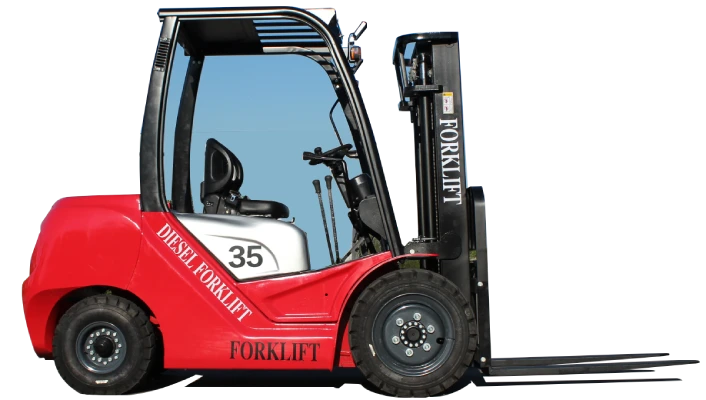
Diesel forklifts are often used outdoors, especially where long runtime, strong power, and rougher operating conditions are required. They are common in building material yards, metal processing, timber yards, ports, and outdoor industrial storage.
YULI diesel forklift options include CPC20/25-K and CPC20/25-KII series with 2-2.5 tons, CPC30-38-K and CPC30-38-KII series with 3-3.8 tons, CPC40-50-H series with 4-5 tons, and CPC100-H with 10 tons. The listed diesel forklift lifting height range is generally 3-6 meters.
Diesel forklifts should be selected carefully for indoor use because exhaust emissions and ventilation requirements matter. For indoor applications, electric forklifts are usually more suitable.
LPG and Dual-Fuel Forklift
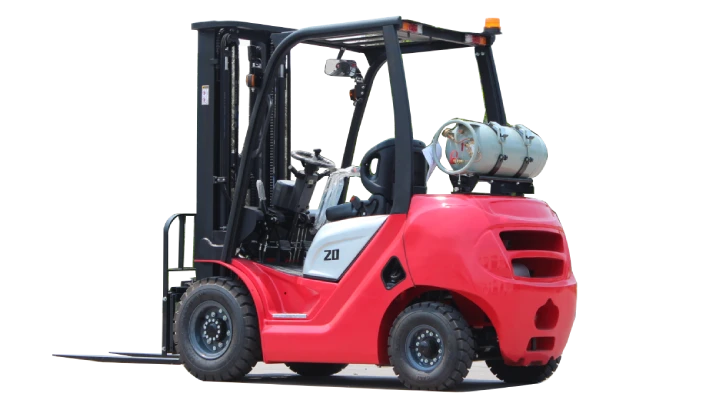
LPG or dual-fuel forklifts can be useful when a business wants quick refueling and flexible operation. YULI lists LPG20-38-K dual-fuel forklifts with 2-3.8 tons rated load and LPG40-50-H dual-fuel forklifts with 4-5 tons rated load. The listed lifting height is 3-6 meters.
A buyer considering dual-fuel should check fuel availability, cylinder storage rules, workplace ventilation, and service support. It may be a good option for some mixed-use operations, but it should not be selected only because it seems more flexible.
Reach Forklift
Reach forklifts are designed for high-rack storage and narrow warehouse aisles. Instead of moving the whole truck forward into the rack, the mast or fork mechanism reaches forward to place or retrieve pallets.
YULI offers seated and stand-on reach forklift models with 1.5-3 tons rated load and 3-8 meters lifting height. These models are most suitable for smooth indoor floors, high storage density, and warehouse racking systems.
A reach forklift is not normally the best choice for rough outdoor work. Its value is in warehouse space efficiency.
Electric Stacker
An electric stacker is smaller than a standard counterbalance forklift and is often used for light warehouse stacking, short-distance pallet movement, and small storage areas.
YULI walk-behind and stand-on stackers cover 1.5-2 tons with a 3-meter lifting height. A walk-behind stacker may suit low-frequency pallet movement, while a stand-on version may be better when travel distance and daily use are higher.
Rough-Terrain Forklift and Telehandler
A rough-terrain forklift is designed for traction and mobility on suitable uneven surfaces. It does not eliminate tip-over risk, and operators still need to consider slope, ground condition, load center, tire contact, and safe travel speed.
YULI lists fuel-powered rough-terrain forklifts with 1.5-5 tons rated load and 3-6 meters lifting height. For higher reach outdoor handling, YULI also lists a diesel telehandler with 5 tons rated load, 13.8 meters lifting height, and 7 meters reach length.
These machines are more suitable for construction, agriculture, outdoor yards, and sites where standard warehouse forklifts cannot move effectively.
YULI Forklift Model Overview
| Product Type | YULI Series / Model | Rated Load | Lifting Height | Power / Operation |
|---|---|---|---|---|
| Electric forklift | CPD10 | 1 ton | 3-6 m | Electric |
| Electric forklift | CPD15/20 | 1.5-2 tons | 3-6 m | Electric |
| Electric forklift | CPD25 | 2.5 tons | 3-6 m | Electric |
| Electric forklift | CPD30/35 | 3-3.5 tons | 3-6 m | Electric |
| Electric forklift | CPD40/45/50 | 4-5 tons | 3-6 m | Electric |
| Three-wheel electric forklift | CPE15/20 | 1.5-2 tons | 3-6 m | Electric |
| Diesel forklift | CPC20/25-K, CPC20/25-KII | 2-2.5 tons | 3-6 m | Diesel |
| Diesel forklift | CPC30-38-K, CPC30-38-KII | 3-3.8 tons | 3-6 m | Diesel |
| Diesel forklift | CPC40-50-H | 4-5 tons | 3-6 m | Diesel |
| Heavy diesel forklift | CPC100-H | 10 tons | 3-6 m | Diesel |
| Dual-fuel forklift | LPG20-38-K | 2-3.8 tons | 3-6 m | Dual-fuel |
| Dual-fuel forklift | LPG40-50-H | 4-5 tons | 3-6 m | Dual-fuel |
| Reach forklift | Seated / stand-on reach forklift | 1.5-3 tons | 3-8 m | Electric |
| Electric stacker | Walk-behind / stand-on stacker | 1.5-2 tons | 3 m | Electric |
| Rough-terrain forklift | Fuel-powered rough-terrain forklift | 1.5-5 tons | 3-6 m | Diesel |
| Telehandler | Diesel telehandler | 5 tons | 13.8 m | Diesel |
What Information Does a Forklift Manufacturer Need Before Recommending a Model?
A reliable forklift recommendation should be based on real working conditions, not only a requested tonnage.
Before recommending a model, a manufacturer such as YULI usually needs to understand the maximum load weight, load dimensions, load center, required lifting height, aisle width, ground surface, daily operating hours, indoor or outdoor use, charging or fuel conditions, tire preference, and attachment requirements.
For example, a buyer may ask for a “3-ton forklift.” But if the load is long, the load center is larger than standard, the lifting height is 5 meters, and the forklift must work on uneven ground, the recommendation may change. The technical team may need to review capacity, mast type, tire configuration, and whether a standard counterbalance model is enough.
This is where manufacturer knowledge becomes valuable. The goal is not only to sell a forklift, but to match the forklift to the work.
How to Choose the Right Forklift
Start with the load. Confirm the heaviest load, the load center, and whether the goods are palletized or irregular.
Then check lifting height. A forklift that handles floor-level transport may not need the same mast as a warehouse stacking pallets at 5 or 6 meters.
Next, look at the operating environment. For indoor warehouses, electric forklifts or reach forklifts are often practical. For outdoor yards, diesel, dual-fuel, rough-terrain, or heavy-duty models may be more suitable.
Also measure aisle width and turning space. A three-wheel electric forklift, reach forklift, or stacker may solve a space problem better than a larger counterbalance forklift.
Finally, compare the total cost of ownership. Purchase price is only one part. Charging infrastructure, fuel, maintenance, spare parts, service response, battery life, tire wear, and downtime all affect long-term cost.
What Is a Forklift Designed to Do
A forklift is designed to lift, carry, stack, and position heavy materials safely over short distances. Its main purpose is not long-distance transportation, but efficient material handling within a defined working area, such as a warehouse, factory, loading dock, construction site, or outdoor storage yard.
In practical terms, a forklift is designed to do four main jobs.
First, it lifts loads that are too heavy or inefficient to move by hand. These loads are often placed on pallets, but forklifts can also handle crates, containers, drums, bundled materials, or special cargo when fitted with the correct attachment.
Second, it transports materials from one point to another within a facility. For example, a forklift may move goods from a truck to a storage rack, from a warehouse to a production line, or from a finished-goods area to a shipping zone.
Third, it stacks and retrieves goods at different heights. This is especially important in warehouses where vertical storage space is used to increase capacity. Depending on the mast type and forklift model, YULI forklifts can support different lifting height requirements, such as 3-6 meters for many counterbalance forklift models and 3-8 meters for selected reach forklift models.
Fourth, it helps position loads accurately. In manufacturing, logistics, and construction, materials often need to be placed in a specific location, not just moved roughly from one area to another. A properly selected forklift gives operators better control when loading trucks, feeding production lines, arranging pallets, or handling heavy components.
A forklift is therefore designed to improve material flow. The right forklift can reduce manual handling, shorten loading time, support safer stacking, and make daily operations more organized. However, it must be matched to the actual load weight, load center, lifting height, working surface, and operating environment.
Forklift Safety Basics
Forklift safety begins with correct selection. A forklift should match the load, surface, height, and working environment.
Operators should follow the capacity plate, keep loads stable and low during travel, avoid sudden turns, slow down on slopes, and separate forklift routes from pedestrian areas where possible. Attachments should be included in capacity calculations because they add weight and may change the load center.
For rough-terrain and outdoor use, surface conditions matter. Large tires and higher ground clearance improve mobility, but they do not make the forklift immune to tipping. Safe operation still depends on load control, slope awareness, and trained operators.
About YULI Forklifts
YULI is a forklift brand of Shandong Leiteng Electric Technology Co., Ltd. The company was founded in 2014 and is located in Qingzhou City, Shandong Province, China. According to the product manual, YULI focuses on electric products and offers multiple forklift configurations, including electric counterbalance forklifts, three-wheel electric forklifts, diesel forklifts, dual-fuel forklifts, reach forklifts, electric stackers, rough-terrain forklifts, telehandlers, pallet trucks, and aerial work platforms.
The manual also states that YULI products support customization across multiple listed models. For buyers, this means the selection process can consider capacity, height, power type, site conditions, and application-specific requirements.
Conclusion
A forklift is a material-handling machine used to lift, move, stack, and transport goods, but choosing the right forklift requires more than knowing the definition. Buyers should compare load weight, load center, lifting height, power type, working surface, aisle space, operating hours, and service needs. With models ranging from 1-ton electric forklifts to 10-ton diesel forklifts and 5-ton telehandlers, YULI can help customers match forklift configurations to real warehouse, factory, logistics, construction, and outdoor handling applications.
FAQ
1. What is a forklift used for?
A forklift is used to lift, carry, stack, load, and unload materials. It is common in warehouses, factories, logistics centers, construction sites, ports, and outdoor yards.
2. What is the difference between a forklift and a reach truck?
A standard counterbalance forklift carries loads at the front and is used for general handling. A reach truck is designed for narrow aisles and high warehouse racks, with forks or mast movement that can reach into storage positions.
3. How much weight can a forklift lift?
It depends on the model. YULI listed models range from 1-ton electric forklifts to 10-ton diesel forklifts, with other options such as 1.5-3 ton reach forklifts and 1.5-5 ton rough-terrain forklifts.
4. Is an electric forklift better than a diesel forklift?
Neither is always better. Electric forklifts are usually better for indoor, clean, and quiet operation. Diesel forklifts are often better for outdoor, heavy-duty, or longer-runtime applications.
5. What should I tell a forklift manufacturer before buying?
Provide load weight, load size, load center, lifting height, working surface, aisle width, indoor or outdoor use, daily operating hours, preferred power type, and any attachment requirements.